
Thermal Imaging vs Ripping Out Tiles: Shower Leak Detection Melbourne for Two-Storey Homes
27th
Oct
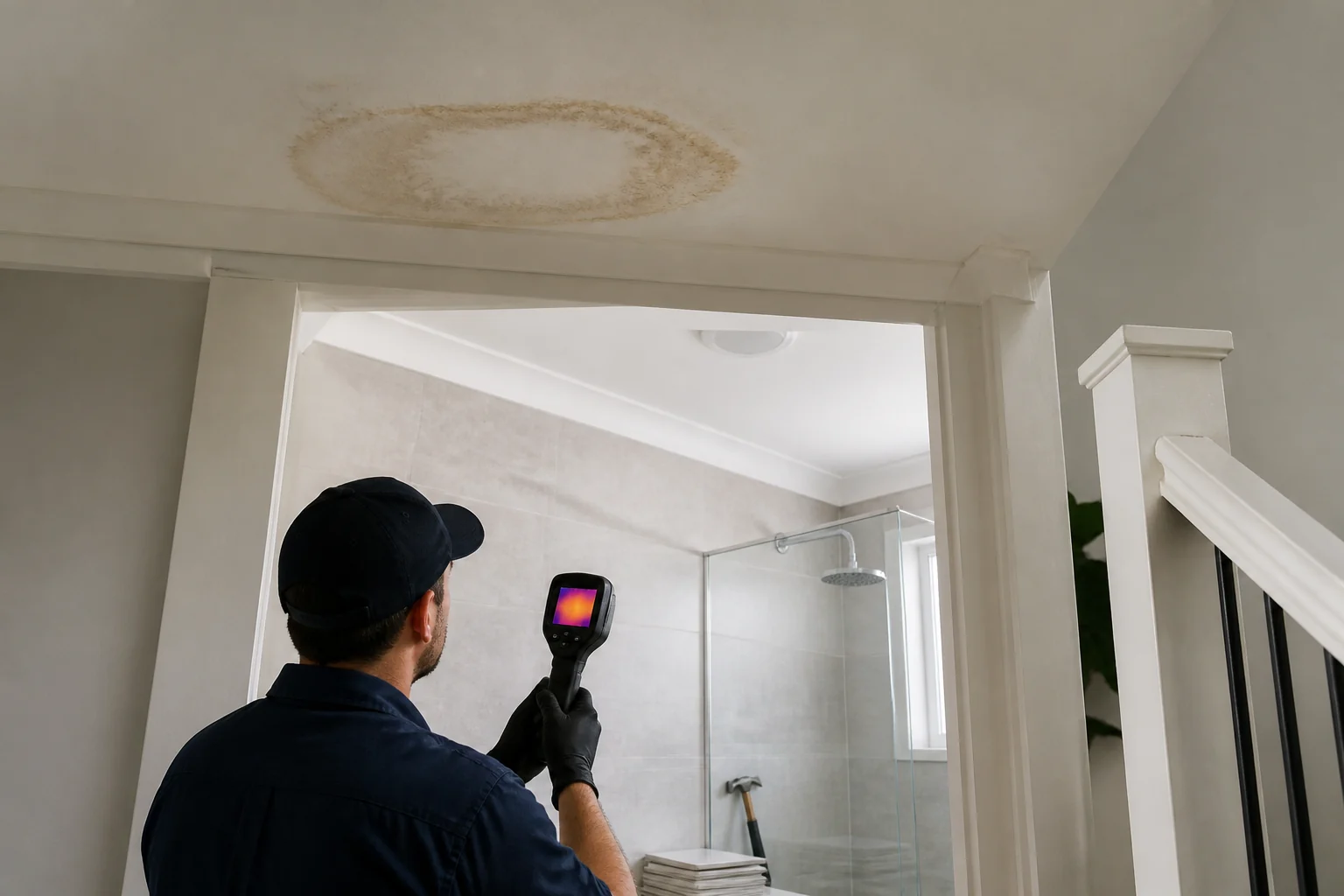
A brown ring on the ceiling under a bathroom is rarely a simple drip. In a two-storey Melbourne house it is usually the end of a path that started in the shower, slipped through grout or a tired joint, sat in timber, and finally found plaster. By the time the stain shows, water has already been moving. Ripping tiles on a hunch is one way to chase that path. It is also one of the more expensive ways to be wrong.
We are Desi Plumbers, a licensed team working across Melbourne, Victoria and Brisbane, Queensland. Households book us for leak detection Melbourne jobs when a shower will not stay dry, or when the room below starts to tell on the room above. We find the path, explain it in plain language, and repair the fault that is actually leaking. When you want a plumber Melbourne households already call for a wet wall, you are speaking to us, including after hours. Weekend work does not add a surcharge.
Here is the practical difference. Thermal imaging, moisture mapping, pressure tests and a controlled flood test sort most shower leaks without a demolition day. Tiles come off when those tests say the membrane has failed, not because a van arrived with a hammer and a guess. That order is how we run shower leak detection and repair Melbourne.
Why the downstairs ceiling speaks first
Tiles look solid. They are a wearing surface, not the waterproof layer. The barrier is the membrane behind or under them, plus sound joints wherever the surface changes: wall to hob, screen to tile, waste to tray. When that system fails, water does not always pool on the bathroom floor. It tracks through failed silicone, crumbling grout, and hairline gaps where the hob meets the wall. Then it travels.
In a large share of Melbourne houses the bathroom sits over a living room, a bedroom, or a stair void. A stain on the downstairs ceiling is often the first public sign. The mark may not sit under the shower. Joists and the fall of the floor carry water sideways before it drops through the lining. The stain shows where water finally left the structure, not always where it entered.
Timber upper floors flex more than a concrete slab. That movement opens hob joints sooner, which is why a two-storey weatherboard or brick veneer can leak at the screen line while the tiles still look tidy. In apartments the path changes again. A slab, a fire barrier, or a suspended ceiling can send water to a light fitting or a party wall instead of a neat circle under the tray. We map both rooms before anyone decides the shower is innocent.
Apartments also add another owner. One leaking shower can wet a neighbour’s ceiling, and insurance arguments get harder when the leak has been running for months. Landlords and property managers usually meet it as two calls: a smell upstairs, a stain downstairs, and no puddle to point at.
On the first call we ask about a short list of signs. They line up with what we find once we are in the house.
- Water stains or a soft patch on the ceiling below the bathroom
- Paint that bubbles or peels near the shower, or on the wall of the next room
- Skirting or architraves that feel soft or look swollen
- A musty smell that lingers after the room should be dry
- Grout that crumbles, darkens, or stays wet for hours
- Silicone that has pulled away from the tile or the hob
- Damp carpet or flooring just outside the screen
- A water bill that climbs without extra people in the house
- Mould in the vanity, or on the far side of a shared wall
- A shower base that never quite dries between uses
A climbing bill can be the only clue. A mixer that weeps into the wall, or a waste that seeps under the base, will not always leave water you can see. We also want one timeline detail: does the stain grow after a shower, after a long bath, or after rain? That answer often splits a bathroom leak from a roof or balcony problem before we unpack a meter.
Upper-floor balconies can wet the same ceiling as a shower. Shower and balcony leaks are often traced with the same mix of instruments and hands-on checks. If the mark tracks a storm and not the morning shower, we look at flashings and gutters before anyone talks about new tiles. That work sits with our roof and gutter leak service, not with a bathroom strip-out.
If water is actively dripping into a bedroom, stop using the shower and close the stop tap for that room if you can reach it safely. A bucket under the stain buys time. It does not find the leak, and it does not dry the joists.
Ripping tiles is a repair, not a detection method
Guesswork with a hammer spends money twice. You pay to destroy a finish, you pay to put something back, and you may still have the original leak if the fault was a mixer body, a waste seal, or a weeping joint in a wall you did not open.
Published ranges for a full re-waterproof and re-tile often sit in a wide band, about $1,500 to $5,000, depending on size and finish, and more if subfloors or the room below are already wet. That figure is a rebuild. It is not the cost of finding the leak. Catching a mixer fault or a failed waste seal early is how a household stays well below it. For anyone watching a budget, that gap is the case for testing first.
There is a second cost quotes sometimes skip. Once tiles are off, the bathroom is out of use. In a two-storey home that is often the only shower. A targeted repair after tests can be finished in a visit. A strip-out cannot. Dust also drops through any floor opening into the room below, so a hasty cut becomes a cleaning job on two levels, not one.
Silicone is not a stand-in for a membrane, and we will not sell it as one. We also will not push a full gut when a plumbing repair will stop the water. When a joint really is the whole fault, resealing is the repair, and we say so. That limited scope is covered on our seal and save page. When the stall is finished and the membrane is gone, we coordinate shower renovation bathroom Melbourne plumbing instead of patching the edges and hoping.
| Approach | What you actually learn | What it costs you | When we use it |
|---|---|---|---|
| Thermal imaging plus moisture, pressure and flood tests | Wet path, pipe versus tray, whether the membrane is in play | Site time, almost no finish damage if tests are enough | First response on a two-storey shower leak |
| Ripping tiles before tests | A view of whatever sits under the piece you chose | Lost tiles, dust below, bathroom out of use, possible wrong spot | Only after tests mark a failed membrane or a pipe with no other access |
Locating the source before anything is touched is the standard we work to. Cameras help us track where water travels beneath tiles, including paths the eye cannot see. The camera is not a licence to skip the tests that follow.
What thermal imaging shows, and where it stops
A thermal camera reads surface temperature. It does not see through tiles the way an X-ray sees bone, and we will not sell it that way. What it does well is outline a wet path, because water changes how a wall or floor holds heat.
Moisture changes the thermal profile of the structure. Water conducts heat more efficiently than dry timber or plaster, so a damp zone often shows as a plume or a streak that does not match the line of a stud. Infrared checks use that temperature difference to mark a location without opening the finish. On a two-storey job we scan the shower walls, the hob, the floor outside the screen, and the ceiling below. A cooler band on the underside of the floor, lining up with a patch in the bathroom, is useful. A random cold spot with no matching moisture reading is not, and we will say so.
Thermal imaging has limits. We work inside them.
- A shower used in the last hour leaves its own heat pattern. We ask when it was last run, and we wait if a reading would be misleading.
- Gloss tiles and metal trims reflect heat from a person, a lamp, or a sunny window. We read several angles, not one tidy frame.
- A slow weep and a saturated membrane can look similar on camera. The image starts the map. It does not close the diagnosis.
- Melbourne winters put brick, timber and glass at different temperatures from the room air. We compare like with like, not the bathroom with the hallway.
- A bathroom that never dries can show widespread coolness from surface moisture and poor airflow. That is not automatically a failed membrane.
A thermal image is cross-checked with moisture meters and a controlled water test. The meter confirms the anomaly is water, not a surface temperature quirk. Meters read walls, floors and the materials around them, which is the step a camera cannot do on its own. Pairing the two is how we start on leaking showers in Melbourne. It is the same first move on those jobs in Brisbane.
A pattern we see in two-storey houses runs like this. The living room ceiling marks near a bulkhead, not squarely under the waste. The meter shows a raised reading in a line toward an external wall. The camera shows a cooler streak along a joist. The mixer holds pressure. A flood test, with the waste isolated, loses water at the hob joint rather than through the outlet. That sequence points to a joint or a membrane, not a burst pipe, and it does it without a pile of broken tiles on the floor.
Bedrooms under bathrooms need a closer look than hallways. Doors stay shut overnight, so mould gets a still pocket of damp air. A faint tide mark on a cornice can be weeks ahead of a drip you can catch in a bowl.
The order we follow before any tile is lifted
Detection stays methodical, and as non-invasive as the job allows. You hear the finding in plain language before we recommend a repair. If you are standing in a half-stripped bathroom wondering what happens next, the order of work has already failed you.
- We talk through what you have seen. Stains, smells, bills, and when it started. In a two-storey house we also ask which room is below, who uses that room, and whether the mark grows after showers or after rain.
- Visual check. Screens, silicone, grout, mixer, rose, waste, and the rooms next door or below. A screen that throws water onto an unsealed join is a different job from a failed membrane.
- Moisture mapping. Meters show where water is sitting, including spots that look dry. We map the downstairs ceiling with the same care as the shower walls.
- Thermal imaging. Temperature differences often outline a wet path behind tiles. We use the images to aim the meters, not to replace them.
- Pressure testing. This isolates supply pipe and mixer faults so we are not blaming grout for a plumbing leak. A shower mixer can leak into the wall cavity for weeks. You may never see water in the stall. The plaster next door tells the story.
- Flood testing of the shower base. Controlled water in the tray shows whether the base and waste hold, without flooding the house. Where the setup allows, we test the outlet and the surrounding bed as separate questions. A leak at the fitting is plumbing. A leak in the surrounding membrane is waterproofing.
- Waterproofing assessment. If the plumbing is sound and water still leaves the tray, we look at membrane and tile failure and name the next step clearly.
You get that finding before we quote. If the issue is not a pipe, we say that. If it is a mixer, a waste seal, or an accessible pipe fault, we often repair it in the same visit, because the vans carry the parts and tools for those jobs. Our leak detection page covers the wider brief when the wet area is not only a shower. Day-to-day pipework, taps and fixtures sit with domestic plumbing when the house needs more than a one-off leak visit.
Faults that look like a failed membrane
Not every leak is a burst pipe, and not every wet wall needs new tiles. Most of the shower jobs we attend start with one of these faults.
Failed silicone and grout. Daily movement, and the small flex in a timber upper floor, opens hairline gaps. Water tracks behind the tile and sits on the membrane. If the membrane is still sound, resealing can be the whole repair. If the membrane has already given way, water sits on bare substrate, and a fresh bead of silicone will fail again.
Compromised waterproofing membrane. Membranes age, get punctured during later work, or were never installed to Australian Standard AS 3740, which sets out how domestic wet areas must be waterproofed. Full membrane replacement with re-tiling is licensed waterproofing work. We diagnose first so you do not pay for a rebuild you do not need. When that rebuild is the honest answer, our bathroom renovation plumbing lines up with the waterproofer and the tiler, rather than leaving you to juggle three trades from a wet ceiling.
Mixer and tap body leaks. The body sits in the wall. A failed cartridge or a loose connection can wet the cavity without a puddle in the stall. Pressure testing picks this up. Replacing the mixer costs far less than ripping out a bathroom because nobody tested the pipes.
Waste, trap, and drain seals. The outlet through the base is a common failure point. Hair and soap hide a failed seal until water is already under the tray. A flood test shows whether the base holds. Many of these are a shower leak fix we can do without lifting the floor.
Screens and hobs. A poorly sealed screen throws water onto unsealed joins. Hobs crack. Water then sits where it should not, sometimes on a surface that was never meant to stay wet.
Supply pipes in the wall. Copper and plastic lines can weep at joints. In some homes this looks exactly like a waterproofing failure until we pressure test. We open a small access where the test marks the pipe, and we tell you before we cut.
Diverters and shower roses. A dripping rose is annoying. A diverter leaking back into the wall is a different problem. We check both, because a new rose does nothing for a diverter that is wetting the cavity.
Showers that never dry. Poor airflow keeps grout saturated and speeds failure. That is a ventilation and use issue as well as a plumbing one, and we will say so if that is what we find. New tiles will not fix a fan that does not extract.
| Fault | What you usually notice | Do tiles have to come off? |
|---|---|---|
| Failed silicone or grout, membrane still sound | Wet joints, damp floor outside the screen | Usually no. Reseal, then retest |
| Mixer or tap body leaking into the cavity | Stain in the next room, no puddle in the stall | No, unless the only access is through tile |
| Waste or trap seal under the base | Water under the tray after use, lingering smell | Often no. Repair from the outlet or an access |
| Weeping supply pipe | Higher bill, wet wall away from the joints | Small access only, where the test marks it |
| Failed membrane under AS 3740 | Flood test loses water, moisture is widespread | Yes. Licensed re-waterproof and re-tile |
| Blocked or leaking waste line | Slow drain, smell, wet patch that follows the pipe | No tile strip if the line is the fault |
When the tiles do have to come off
There is a point where leaving the tiles on is the expensive choice. If a flood test shows the tray or the wall bed will not hold, and pressure tests have cleared the supply, the membrane is the job. AS 3740 applies. We will not dress that up as a silicone visit.
What we will do is keep the opening matched to the finding. A local failure at a hob, confirmed by meters and a flood test, is not the same quote as a whole-room strip because the grout looks tired. If the substrate is swollen, if particleboard has gone soft, or if the ceiling below is sagging, the repair grows, and we say that before work starts. Timber joists that have been wet for months do not forgive a cosmetic patch.
In stacked apartments the same rule protects the neighbour. Stopping water today, then planning the membrane work, is better than a weekend of open tiles with nobody booked to waterproof them. We quote the plumbing scope clearly, and we name the waterproofing scope as separate licensed work. You should not pay a plumber to pretend a tube of sealant replaced a membrane.
If the bathroom is being rebuilt properly after that finding, some Brisbane households add a bidet at the same time. We handle toilet bidet installation with an atmospheric vacuum breaker, so the new fitting meets backflow rules instead of creating a fresh risk beside a new membrane.
Speed, and why two storeys cannot wait for Monday
Water in a wall does not wait for a convenient Saturday. Timber joists swell. Particleboard floors lose strength. Mould follows moisture, and that is a health issue as well as a building one. In a two-storey house the room below is often a bedroom. Sleeping under an active leak is a poor plan, even for one night.
Acting while the leak is still local keeps the bill in a range most households can plan for, instead of a full strip-out plus floor repairs. We run emergency plumbing 24/7 for that reason. Stopping water at 7pm on a Sunday does not come with a weekend penalty. That is one of the ways we keep the job affordable for households, landlords, and small businesses.
The same rule applies in Queensland. Brisbane humidity gives mould a head start, and a wet wall in a two-level townhouse or a Queenslander can travel along the frame before anyone sees a drip on the floor. Our Brisbane crews use the same test order: fast attendance, a clear quote, licensed work. If the search is emergency plumber Brisbane, or plumber Brisbane near me, you still get a technician who explains the fault before any tile is touched. Those paths are on our emergency local plumber near Brisbane and plumber Brisbane near me pages. How the team is set up across both cities is on about us.
When the stain is a drain, a heater, or the next room
A leaking shower is often the job that gets us in the door. It is not always the cause of the mark.
A recurring slow waste can be a blocked pipe, not a membrane. We offer blocked drain clearing and CCTV drain inspection so you see the pipe, not a guess. Tree roots, collapsed lines, and grease show up on camera. Hydro jetting clears stubborn build-up when a cable is not enough. The same cameras and machines cover a blocked toilet, a blocked sink, a blocked basin, and a blocked storm pipe when roof water is backing up near the same wall.
In older Melbourne clay, and in established Brisbane suburbs, roots are a regular find. We trace them on our drain tree roots visits before anyone talks about digging. If the line is cracked or collapsed, drain repair and replacement is the honest next step, not another bottle of cleaner and another stained ceiling.
A hot water unit can mimic a shower leak. Storage heaters, tempering valves, and concealed pipes weep into cavities that share a wall with the bathroom. The ceiling mark then looks like a tray failure until we pressure test. If the heater is the fault, we repair it or carry out a hot water installation that matches the household, without lifting shower tiles that were never the problem. Where the unit is gas, our licensed gas plumbing team tests the joints rather than assuming the shower membrane failed.
The room next door can add to the confusion. A leaking sink waste on a shared wet wall can track into the ceiling below and sit beside a bathroom stain. We check that path before we name the shower guilty. The wider list, from leaks to maintenance, is on our services page, including commercial plumbing services for shops, offices, and strata amenities that cannot close for a week of guesswork.
Frequently asked questions
Can you find a shower leak without ripping tiles?
In most two-storey jobs, yes. We start with moisture mapping, thermal imaging, pressure tests, and a controlled flood test. Tiles come off only when those tests show the membrane has failed, or when a pipe has no other sensible access. That is the point of leak detection Melbourne households book us for: find the path first, then repair what is actually wet.
Why is the stain not directly under the shower?
Joists and the fall of the floor carry water sideways before it drops through the plaster. The stain shows where water left the structure, not always where it entered. A mark near a bulkhead, a cornice, or a light fitting can still belong to the shower. We map both rooms before we clear the tray, or blame it.
Do you charge more on weekends or after hours?
No. Weekend and after-hours attendance does not add a surcharge. We run emergency plumbing 24/7 in Melbourne and Brisbane, so a Sunday night leak is not priced as a penalty. You still get the same test order, and the same plain explanation, as a weekday visit.
When do the tiles have to come off?
When a flood test shows the tray or the wall bed will not hold, and pressure tests have cleared the supply. That is membrane work under AS 3740, and it needs licensed waterproofing, not a thicker bead of silicone. Tired grout on its own is not a reason to strip the room. A soft substrate or a sagging ceiling below is.
Is a thermal camera enough on its own?
No. It reads surface temperature. It does not see through tiles the way an X-ray sees bone. Gloss, a recent shower, and a cold Melbourne morning can all fake a pattern. We cross-check every image with moisture meters and a water test before we name the fault.
What if the mark appears after rain, not after a shower?
Then we look at flashings, gutters, and balcony details before anyone talks about new tiles. A roof or gutter leak can wet the same ceiling as a shower. If the stain grows after storms and stays quiet after a long shower, the bathroom may be innocent.
Do you only work on houses?
No. Homeowners, landlords, property managers, and commercial operators all book the same process. A staff shower, a clinic amenity, or a small shop bathroom gets moisture tests and a clear scope, not a strip-out on arrival. Our commercial plumbing services cover planned maintenance as well as the urgent call.
Can a hot water unit or a blocked drain cause the same ceiling stain?
Yes. A weeping heater, a tempering valve, or a waste line that leaks along its run can mark the ceiling without a failed shower membrane. Slow drainage, a smell that follows the pipe, or a bill that climbs with no extra showers are the clues. CCTV drain inspection and a pressure test sort those from a tray fault before any tile is lifted.
Book the test before anyone lifts a tile
If the ceiling under your bathroom is marking, or the shower never quite dries, talk to us before a hammer comes out. We will find the path, tell you what it means in plain language, and repair the fault that is actually leaking. The same crew covers Melbourne and Brisbane, including after hours, with no weekend surcharge.
Send the photos and the timeline through contact us, or start from the home page if you want a quick look at how we work. If the leak is active tonight, use our emergency plumbing line and we will get a licensed technician moving. Testing first is the cheaper path. A strip-out can wait until the tests say it cannot.